Stainless vs. Granite, Quartz, and Wood for Busy Kitchens
We walked a frustrated homeowner through stainless steel vs. granite, quartz, and butcher block so his busy kitchen would finally get countertops that can keep up.
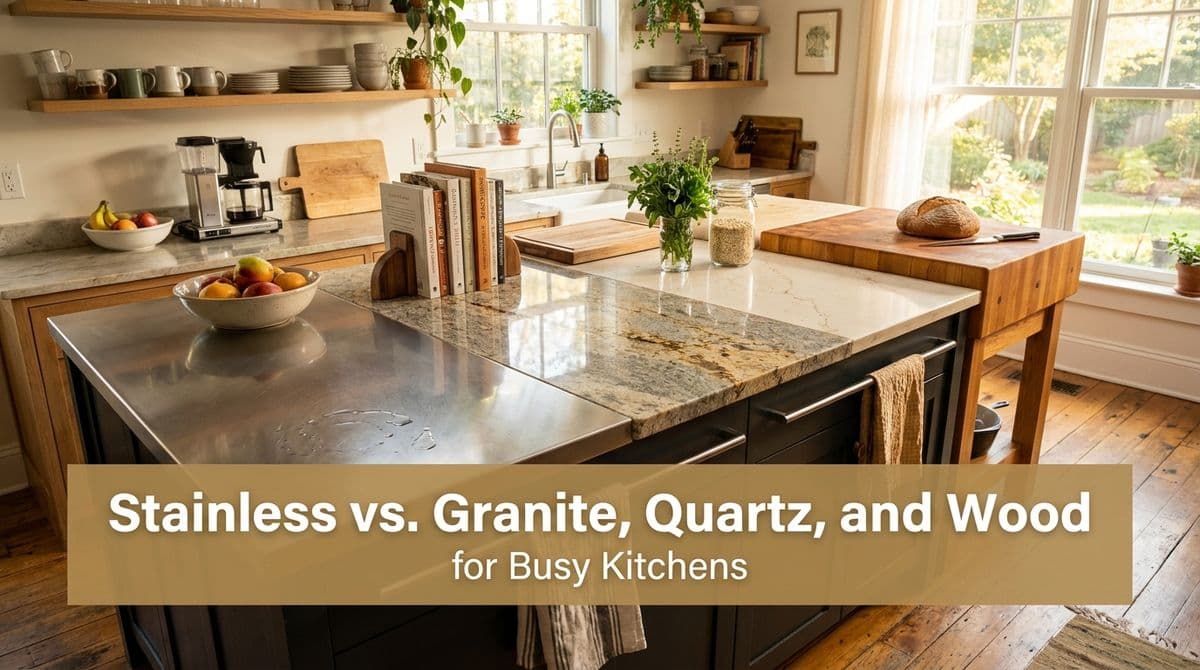
Why One Homeowner Ditched Granite for Stainless Steel
We recently got a call from a homeowner — let’s call him Mark — who was at his wits’ end with his kitchen countertops.
Mark had been through granite and quartz, and he told us he was “tired of them breaking all the time.” He’d been calling around town trying to find someone who would actually do stainless steel countertops, and kept hitting dead ends. When he finally reached us, he already had rough measurements ready, was willing to remove his old tops himself, and just needed to know:
- Is stainless steel really more durable than granite and quartz?
- How does it compare to butcher block?
- What does it cost?
- What kind of maintenance are we signing up for?
We walked Mark through all of this on the phone, and we figured we’d break it all down here for anyone else trying to pick the right countertop for a busy kitchen.
Stainless Steel Countertops: What You’re Really Getting
When we talk about stainless for kitchens, we’re usually talking about custom-fabricated sheets that we form over a substrate (typically plywood), weld the edges, and finish so everything is solid and stout. That’s exactly what we planned for Mark’s project.
Pros of stainless steel countertops:
- Extreme durability: They don’t crack or chip the way stone can. That was a big reason Mark wanted out of granite and quartz.
- Heat resistant: You can set hot pans down without worrying about burns or discoloration.
- Non-porous and hygienic: No sealing, no staining, and very resistant to bacteria — this is why you see them in commercial kitchens.
- Seamless integrations: We can weld in sinks, drainboards, and backsplashes for a smooth, easy-to-clean surface.
Cons of stainless steel countertops:
- Scratches and swirl marks: Stainless will scratch. Over time, those marks blend into a soft patina, but if you want a perfectly pristine surface forever, stainless may bug you.
- Noise: Setting pots and pans down can be louder than on stone or wood, though a good substrate helps dampen the sound.
- Fingerprints and smudges: Especially on polished finishes. Brushed or satin finishes hide them much better.
Stainless vs. Granite and Quartz
Mark’s biggest complaint was that his granite and quartz kept “breaking.” We see this fairly often — especially around sink cutouts, corners, and overhangs.
Granite and quartz pros:
- Lots of colors and patterns to choose from.
- Very hard and scratch-resistant on the surface.
- Perceived as a “luxury” material for resale.
Common issues we see with stone:
- Cracks and chips: A heavy pot or someone leaning hard on an overhang can crack a slab.
- Seams: Longer runs usually need seams that can be visible or collect grime.
- Maintenance: Granite often needs periodic sealing; quartz can be sensitive to high heat.
Stainless, on the other hand, won’t randomly crack. If a busy family kitchen sees a lot of hard use — kids, big pots, parties — stainless tends to age better structurally, even if it does pick up cosmetic scratches.
Stainless vs. Butcher Block
When Mark mentioned butcher block, he shut it down pretty quick: “Yeah, I’m not doing that.” We understood why. We’ve been seeing a big trend toward butcher block, but it comes with trade-offs.
Butcher block pros:
- Warm, natural look that softens a kitchen.
- Can be sanded and refinished if damaged.
- Great as an accent (like an island), not always ideal as the main prep surface.
Butcher block cons:
- High maintenance: Needs regular oiling or sealing to avoid drying, staining, and water damage.
- Not as hygienic when neglected: Moisture and food particles can soak in if it isn’t maintained.
- Price: As we told Mark, good butcher block is often just as expensive as stainless these days, and harder to keep nice.
For homeowners who love the look of wood, we often suggest a mix: stainless in the main work zone, butcher block as a secondary surface. For someone like Mark who wants low-fuss durability, stainless across the main kitchen usually wins.
Cost Range: Stainless vs. Other Countertops
Every project is different, but here’s how pricing usually shakes out in our market for a typical kitchen, excluding removal of existing tops (Mark offered to handle his own demo to help control costs):
- Stainless steel: Often in the mid-to-high range, similar to a good quartz or premium butcher block, depending on thickness, edge details, integrated sinks, and layout.
- Granite: Wide range — basic colors can be lower than stainless; exotic slabs can be much higher.
- Quartz: Typically comparable to or slightly more than mid-range granite, often similar to stainless.
- Butcher block: Quality hardwood tops are no longer the “cheap” option; as we told Mark, they’re frequently in the same ballpark as stainless.
One cost factor Mark brought up was removal of old countertops. If you handle the demo and prep yourself — carefully, so cabinets aren’t damaged — that can shave some labor off our estimate. If we do the removal, we factor in extra time for disconnecting sinks, safe demo, and haul-off.
Maintenance for Busy Kitchens
Here’s how day-to-day care compares for the four materials, the way we explained it to Mark:
Stainless steel:
- Clean with mild soap and water; wipe with the grain.
- Avoid harsh abrasives that cut across the grain.
- Accepts a “lived-in” patina of fine scratches over time.
Granite:
- Needs periodic sealing (depending on the stone and sealer).
- Wipe spills quickly to avoid staining on lighter stones.
- Use cutting boards to protect both your knives and the sealer.
Quartz:
- Low maintenance — no sealing needed.
- Protect from high heat; use trivets under very hot pans.
- Clean with non-abrasive cleaners to preserve the finish.
Butcher block:
- Regular oiling or sealing is essential.
- Wipe water quickly; don’t let spills sit.
- Expect to sand and refinish periodically in high-use areas.
Is Stainless Right for Your Kitchen?
For Mark, the answer was an easy yes: he wanted something that wouldn’t crack, didn’t need sealing, and could take a beating in a busy kitchen. Stainless checked every box.
If you’re cooking a lot, have a busy household, or are just tired of babying your countertops, stainless is worth a serious look alongside granite, quartz, and butcher block. And if you’re planning a project, it helps to know ahead of time whether you’ll handle demo yourself or want us to include removal in the estimate — that’s one of the first questions we’ll ask when we price your job.
Thinking about a stainless countertop project of your own? We’re always happy to walk through measurements, material options, and what makes the most sense for the way you actually use your kitchen.